 Graziano Mangoni
The history and the chronicles of the time pass on the ancient love of Gabriele d'Annunzio with the city of Mantua and the Palazzo Ducale, enriched by original anecdotes as original was his adventurous life often beyond the lines but that makes him, as well as an illustrious writer, an inimitable character.
The poet visited the Virgilian city at least four times, always remaining enchanted by the bridge of San Giorgio, with the view of the castle, and fascinated by the calm waters of its lakes and by the croaking of the frogs which, according to him, exceeded even those of Ravenna in harmony . His great love, however, was Palazzo Ducale from the first time he arrived in Mantua in May 1907, and it is in the Gonzaga palace that he was struck by the wooden ceiling of the Labyrinth room with the inscription "Forse che si, forse che no", the motto of the title of his book then published by the Treves brothers of Milan in 1910.
Obviously d'Annunzio thought about it before giving the novel its title because, when he returned for the second time to the Doge's Palace in September 1909, he visited and admired for a long time the wooden labyrinth ceiling of one of the ducal rooms.
In his excursions in the city he did not fail to go to the Basilica of Sant'Andrea to visit the chapel with the tomb of Mantegna, while the third time, it was March 1910, the poet arrived in Mantua in the late afternoon and regretted not being able go to the Doge's Palace, but held a learned lecture at the Teatro Sociale recalling, among other things, the homeland of Virgil long celebrated in Dante Alighieri's Divine Comedy.
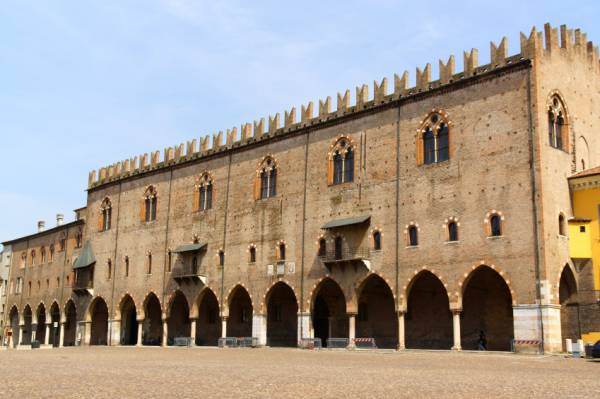
The last time, as far as we know, that Gabriele d'Annunzio returned to Mantua was in July 1937 to visit the Iconographic Gonzaghesca exhibition set up in the Doge's Palace with paintings displayed in the Sala di Apollo or Sala degli Stucchi in the large apartment of the Castle. On that occasion, hundreds of works from the most important museums in Italy and Europe were exhibited in the exhibition, signed by Pisanello, Donatello, Mantegna, Raphael, Titian, Pourbous, Rubens and many other artists. It was certainly a grandiose event, never repeated in Gonzaga portraiture, in which excellent guests took part. In addition to the poet there was the presence of King Vittorio Emanuele III and Prince Umberto di Savoia. The exhibition was also held with the inauguration of the restoration of the palace and, in particular, of the Camera Picta del Mantegna that the great poet was able to admire in all its splendor. To his companions during the visit, he jokingly stated: "I want to come and stay in the Doge's Palace always. Do you want me as custodian, as a clerk of the Palace?" It is presumed by the Director of Clinio Cottafavi to whom the restorations are due to receive as a tribute an etching by Antonio Carbonati, a Mantuan artist who had acquired a certain fame also in Paris, which depicted the much loved Palazzo Ducale. We think that there could not have been a more welcome gift for d'Annunzio, just as the will was for the Society for the Palazzo Ducale, a historic non-profit association established in 1902, the testamentary donation of over five hundred works by artist.
GRAZIANO MANGONI President of the Society for the Doge's Palace
* The article is based on news from Gilberto Scuderi's book "Mantua -docet-history of a fantastic city"

...propter aquam, tardis ingens ubi flexibus errat Mincius et tenera praetexit harundine ripas. (Georg. III, 10-15)
 C/O Società Dante Alighieri


